
Play Rise of Olympus Now!
Home → Symbols & Payouts
Rise of Olympus Symbols
Symbol set of Rise of Olympus
Rise of Olympus by Play'n GO uses a 5x5 reel layout that supports Cluster Pays mechanics rather than traditional paylines. This All Ways structure allows symbols to form winning groups horizontally or vertically without needing to align on specific lines. The grid provides ample space for the increasing multiplier feature to activate during consecutive drops in the bonus round.
Rise of Olympus paytable and grid
| Grid | 5x5 cascading grid |
| Paylines / ways | Cluster Pays / All Ways |
| Top symbol payout | Pegasus Wild - 50x bet for 5 |
| Bonus trigger | Clear the whole grid in the base game |
The game features Greek mythology themed icons ranging from low-value card ranks to high-paying divine figures. These symbols drive the cluster formations that trigger payouts across the five reels. The visual design supports the thematic elements while ensuring clear distinction between symbol values for accurate win calculation.
In comparison, Book of Dead by Play'n GO utilizes a compact 5x3 reel layout with fixed paylines. This structural difference means Rise of Olympus offers more potential connection paths for clusters. Players navigating the larger grid must account for the distinct spatial requirements when evaluating potential win opportunities.
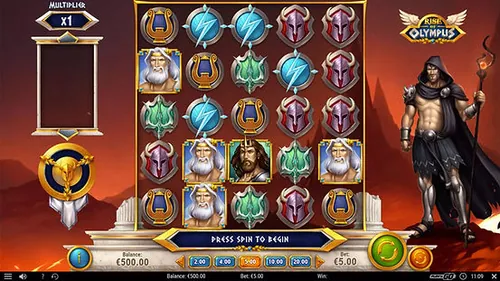
High-paying symbols
The high-paying symbols in Rise of Olympus represent key deities from Greek mythology within the Play'n GO title. These premium icons carry significant value when they form valid clusters on the 5x5 grid. Their presence is crucial for achieving substantial payouts given the game's high volatility setting.
Each cluster of five or more matching high symbols contributes directly to the total win amount. The theoretical RTP of 96.50% relies heavily on these frequent high-value combinations appearing during base gameplay. Players should expect these symbols to drive the majority of their return over extended session durations.
Book of Dead features high symbols on its 5x3 grid with an RTP of 96.21%. Rise of Olympus maintains a slightly higher return percentage at 96.50% despite using different symbol tiers. This mathematical advantage helps offset the impact of the house edge during standard play phases.
Low-paying symbols
Low-paying symbols in Rise of Olympus consist of standard card ranks that fill the remaining grid spaces. These icons appear frequently but offer minimal returns when forming small clusters on the 5x5 layout. They serve primarily as fillers to maintain visual density and support occasional minor wins.
When players land clusters of these lower-value icons, the payout remains modest compared to deity symbols. The high volatility ensures that such wins are infrequent and often do not cover the stake cost. Consequently, reliance on these symbols alone rarely generates sustainable profit margins for average players.
Contrast this with Book of Dead where low symbols operate on a 5x3 grid with 96.21% RTP. Rise of Olympus utilizes a wider 5x5 area allowing more complex cluster formations. This expanded layout increases the probability of landing multiple small wins simultaneously despite lower individual payouts.
Wild symbol behaviour
Rise of Olympus does not utilize a traditional wild symbol that substitutes for other icons on the reels. Instead, the game relies on the expanding and sticky mechanics of special symbols during the free spins feature. This absence shifts focus toward the cluster formation mechanics inherent to the Play'n GO design philosophy.
The lack of substitution means every winning combination must consist of identical regular symbols connecting on the grid. Players cannot rely on wild cards to complete partial clusters or bridge gaps between separated symbols. This constraint demands precise alignment of matching deity or card icons to trigger any payout event.
Book of Dead includes wild symbols that substitute for other icons on its 5x3 grid. Rise of Olympus replaces this mechanic with pure cluster pays requiring exact matches. The divergence highlights how Play'n GO prioritizes geometric alignment over symbolic flexibility in this specific title.
Scatter symbol behaviour
Scatter symbols in Rise of Olympus function independently of position to trigger the bonus feature regardless of their location. These special icons do not need to align on adjacent reels or specific patterns to activate free spins. Their placement anywhere on the 5x5 grid initiates the core gameplay loop involving increasing multipliers.
Once triggered, the scatter mechanism transitions the player into a mode where consecutive drops increase the win multiplier. This feature defines the high volatility nature of the Play'n GO slot by offering potential max wins up to 5000x. The scatter acts as the gateway to the most lucrative phase of the game session.
Book of Dead uses scatters on a 5x3 grid with an RTP of 96.21% to trigger bonuses. Rise of Olympus employs a similar trigger but applies it to a 5x5 cluster-based structure. Both titles use scatters to unlock bonus rounds, yet the subsequent multiplier mechanics differ significantly in execution.
Rise of Olympus: key facts
| Parameter | Value |
|---|---|
| Game | Rise of Olympus |
| Studio | Play'n GO |
| Released | 2019 |
| RTP | 96.50% |
| House edge | 3.50% |
| Volatility | high |
| Max win | 5000x |
| Reels | 5x5 |
| Paylines / ways | Cluster Pays / All Ways |
Reading the paytable
The theoretical return to player percentage for Rise of Olympus stands at 96.50% according to Play'n GO specifications, which implies a house edge of exactly 3.50%. This metric reflects long-term averages over hundreds of thousands of spins rather than short session predictions. Players should understand that this figure represents the expected payout ratio relative to total wagers placed on the 5x5 grid structure.
In contrast to Reactoonz by the same developer, which offers an RTP of 96.51%, Rise of Olympus sits slightly lower in terms of statistical return. The difference between these two percentages is marginal but mathematically distinct for analytical purposes. Gamblers tracking variance will note that both titles share high volatility characteristics despite the slight deviation in their respective return rates.
How wins are calculated
Win calculations rely on Cluster Pays mechanics where symbols must touch horizontally or vertically to form valid groups on the reels. Unlike traditional line-based games, there are no fixed paylines to monitor during gameplay sessions. This method allows matches to form anywhere on the 5x5 layout as long as adjacent symbols create a connected group.
Line wins versus ways wins
Rise of Olympus utilizes All Ways logic instead of standard line structures, meaning any adjacent matching symbols from the leftmost reel generate payouts. This approach eliminates the need to align specific patterns across defined rows or diagonals. Players benefit from increased winning opportunities since clusters can form in multiple configurations across the grid width.
Bet size and symbol value
The maximum win potential reaches 5000x the stake, capping the highest possible payout regardless of bet size entered into the interface. High volatility ensures that such large wins occur infrequently compared to low-variance alternatives. Analytical models suggest players require substantial bankrolls to survive dry spells before hitting significant cluster combinations.
Multipliers on the Multipliers on the reels
Consecutive symbol drops trigger increasing multipliers within the feature set, enhancing payout values during successful cluster sequences. These escalating factors apply directly to the base win amount generated by each valid group. The mechanic rewards sustained winning streaks more heavily than isolated single-spin victories on the 5x5 board.
Special symbols in the bonus
The cluster pays mechanic drives the core gameplay loop of Rise of Olympus, a slot developed by Play'n GO. This system replaces traditional paylines with adjacent symbol groups that must touch horizontally or vertically to form a winning combination. Players observe consecutive drops during a feature round, where each successful cascade increases the multiplier value applied to subsequent wins. The increasing multiplier creates a compounding effect on payouts as the grid clears and new symbols fall into place.
Wild substitutes act as essential connectors within the 5x5 reel layout, helping to bridge gaps between non-matching symbols. These special icons can replace any standard symbol to complete a valid cluster, thereby extending the duration of a spin sequence. In contrast, Legacy of Dead uses wilds solely for substitution without grid-wide interaction mechanics. This distinction highlights how Rise of Olympus integrates symbol utility directly into its unique cascading win structure for higher engagement.
Scatter symbols trigger the primary bonus round when three appear anywhere on the reels, regardless of their position relative to one another. Once activated, the game enters a distinct phase where multipliers accumulate independently of the base game's random number generation. This transition marks a significant shift in volatility behavior, offering players access to the potential maximum win cap of 5000x their stake. The bonus features are central to achieving high returns during extended play sessions.
Symbol upgrades and collections
The theoretical return to player stands at 96.50%, indicating a house edge of 3.50% over an infinite series of spins. This percentage represents the average payout expected from every euro wagered across hundreds of thousands of game rounds. By comparison, Legacy of Dead offers a slightly higher RTP of 96.58%, suggesting a marginally lower long-term cost for players. Understanding this metric helps manage expectations regarding the frequency and size of wins over time.
High volatility defines the risk profile of Rise of Olympus, meaning wins occur less frequently but tend to be larger when they happen. This characteristic aligns with the high-risk appetite required to chase the maximum win potential of 5000x the initial bet. Players should anticipate longer dry spells between successful clusters compared to low-variance alternatives like Legacy of Dead. Such variance requires a sufficient bankroll to withstand periods without significant returns during extended gameplay sessions.
Cluster Pays mechanics dictate that symbols must connect adjacently to generate rewards, creating dynamic interactions on the 5x5 grid. Unlike fixed paylines, All Ways systems allow matches from left to right without specific pattern constraints, increasing potential combinations. This flexible structure supports the cascading feature, where winning symbols disappear and new ones drop down to fill empty spaces. The resulting chain reactions can significantly boost total payouts within a single spin cycle.
Premium symbols contribute disproportionately to the overall payout structure due to their higher base values in the paytable. These icons often serve as key components for triggering special events or activating higher multiplier tiers during bonus rounds. Their appearance frequency is balanced against lower-value symbols to maintain the designated volatility level set by Play'n GO. Strategic observation of these symbols aids in understanding the underlying probability distribution governing each spin outcome.
Grid layout and symbol positions
The 5x5 reel layout provides a spacious canvas for the Cluster Pays mechanism to operate effectively across multiple dimensions. This square configuration allows for complex adjacency patterns that differ significantly from traditional 3-reel or 5-reel linear setups. Play'n GO designed this structure to facilitate frequent cascading wins, where cleared symbols are replaced by new ones falling from above. The expanded grid area increases the statistical likelihood of forming large clusters compared to narrower formats used in other titles.
Symbol positions determine whether a cluster forms, as only horizontally or vertically touching identical icons count toward a win. Diagonal connections do not qualify, enforcing strict adjacency rules that challenge players to watch carefully for contiguous groups. This positional constraint adds a layer of strategic depth, requiring attention to the spatial arrangement of symbols after each cascade. The rigid positioning ensures that every win results from precise alignment rather than random chance alone.
Reel stops are synchronized to ensure that new symbols drop simultaneously, maintaining the integrity of the cascading feature throughout the spin. This synchronization prevents partial updates that could disrupt the visual flow or mathematical accuracy of the payout calculations. Each drop phase resets the board state, allowing fresh opportunities for cluster formation without manual intervention from the user. The seamless integration of gravity-based symbol movement enhances the immersive quality of the Greek mythology theme.
Frequency of premium symbols
Hit frequency varies significantly based on the volatility setting, with high-variance slots like Rise of Olympus producing fewer but larger wins. Players might experience extended periods without significant payouts before hitting a substantial cluster that triggers the multiplier feature. This pattern contrasts with lower-volatility games that offer more frequent small wins, providing a steadier but less explosive return curve. Managing bankroll accordingly is essential to survive the inevitable dry spells inherent in high-risk gameplay strategies.
The maximum win cap of 5000x sets a hard limit on potential earnings per spin, regardless of multiplier accumulation during bonuses. This ceiling applies uniformly across all stake levels, ensuring that no single outcome exceeds the predefined payout boundary. While rare, achieving this cap requires a perfect alignment of premium symbols and consecutive cascades within the bonus round. Understanding this limit helps players gauge the realistic upside potential versus the statistical probability of reaching such extreme outcomes.
Wagering requirements associated with the 300% welcome bonus up to €2,000 influence how quickly players can withdraw winnings from free spins. These terms typically mandate a turnover equal to forty times the bonus amount before cashing out becomes permissible. For example, a 100 € bonus would require 4,000 € in total bets to satisfy the condition fully. Compliance with these rules affects the net profitability of using promotional funds on high-volatility titles like Rise of Olympus.
Paytable details worth checking
The paytable outlines the base values for each symbol type, ranging from low-cost icons to high-paying premium characters. These values serve as the foundation for calculating cluster payouts before any multipliers or bonus features are applied. Players should review these baseline figures to understand how different symbol combinations translate into monetary returns. Knowledge of the paytable structure aids in assessing the value of each spin outcome accurately.
Bonus features activate through specific scatter configurations, unlocking the free spins round where multipliers increase with each cascade. During this phase, the potential for exponential growth exists as consecutive wins compound the multiplier value applied to subsequent clusters. This mechanic distinguishes Rise of Olympus from simpler slots that rely solely on static payouts without dynamic enhancements. The escalating multiplier system rewards sustained performance within the bonus round significantly.
RTP remains constant at 96.50% across all standard gameplay modes, ensuring consistency in long-term theoretical returns. This figure does not fluctuate based on bet size or feature activation, providing a stable expectation for analytical purposes. Deviations from this average in short sessions are normal due to variance, but long-run data converges toward the stated percentage. Monitoring actual performance against this benchmark helps identify whether gameplay aligns with expected statistical norms.
DemoRTP & VolatilitySymbols & PayoutsBonus FeaturesStrategyBonusesMobileDownload & AppMax WinSimilar GamesReviewFAQSitemap
Rise of Olympus 2026